
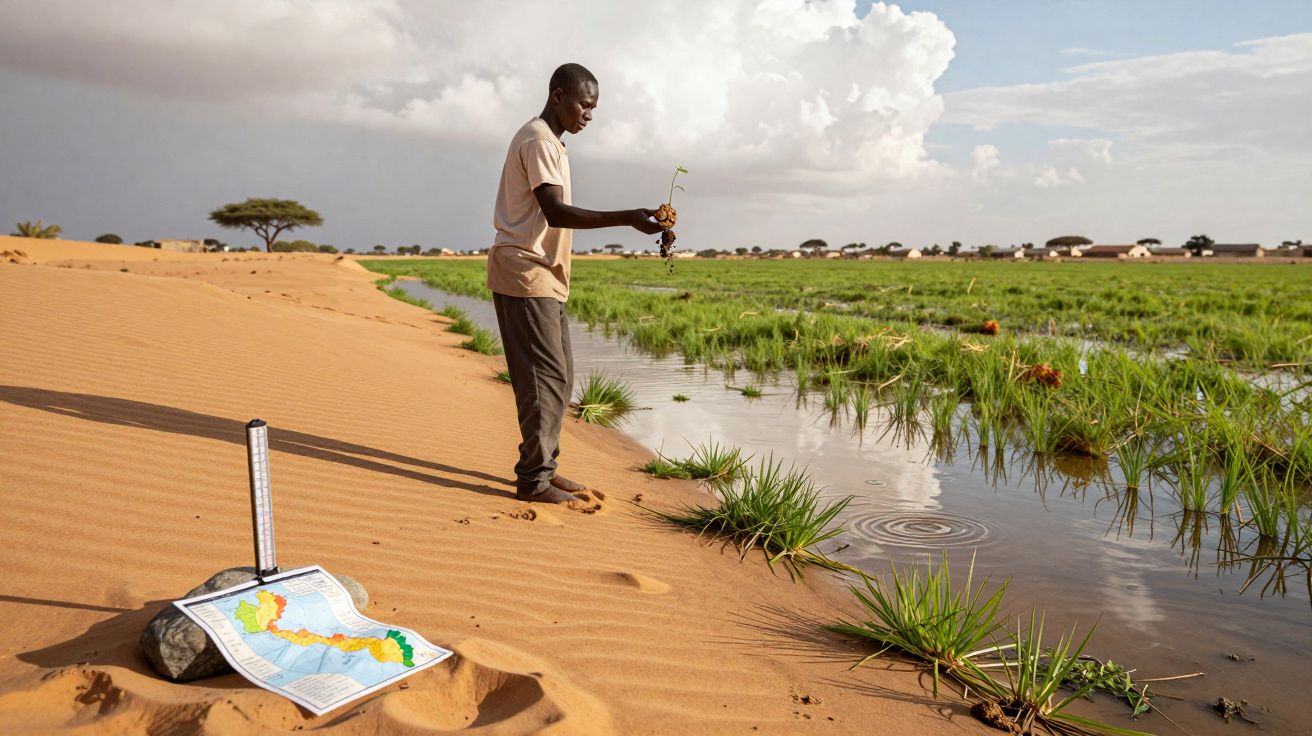
A desert known for its cloudless skies could, within a few decades, see storms where today there is only dust and silence.
New climate projections suggest the Sahara is heading towards a future of much heavier rainfall, with impacts that extend far beyond the desert itself-threatening farming systems, cities and ecosystems across much of Africa.
A continent suspended between drought and reliance on rain
Africa’s climate hangs by a tight rope between two forces: chronic dryness and an almost total dependence on seasonal rainfall. Monsoons, moisture fronts, and winds coming in from the Atlantic and Indian oceans determine whether there will be food on the table, water in reservoirs and grazing for livestock.
Research published in 2025 in npj Climate and Atmospheric Science, led by scientists at the University of Illinois Chicago, points to a dramatic shift in this fragile balance. According to the study, the Sahara-an emblem of aridity-could receive up to 75% more rain by the end of the century.
More rain in the world’s largest hot desert does not automatically mean greater water security. It can mean greater risk.
The researchers examined around forty climate models under two global emissions pathways: an intermediate scenario (SSP2‑4.5) and a high‑emissions scenario (SSP5‑8.5). In both, the message is similar: the atmosphere over Africa becomes more humid, more unstable and more prone to extreme events.
Why the Sahara could become much wetter
To reach these conclusions, the team led by researcher Thierry Ndetatsin Taguela compared climate data from 1965 to 2014 with simulations running through to 2099. The central driver is global warming: the warmer the air, the more water vapour it can hold.
When that moisture meets favourable conditions, it forms denser clouds and more intense storms. That is where major shifts in atmospheric circulation come in.
Hadley cells on the move
The study indicates that warming shifts the so‑called Hadley cells northwards-vast air circulation loops in which warm air rises in the tropics, flows aloft, and then sinks in the subtropics. These cells control a large share of the planet’s tropical rainfall patterns.
With this shift, areas that have traditionally been extremely dry across the Saharan belt would be more exposed to moisture flows and the formation of storm clouds.
The study projects that more than 70% of the new moisture in the Sahara would come from convective rainfall-the kind typical of fast, intense storms.
In practice, the desert’s margins could begin to take on features of semi‑arid zones or even seasonal savannahs, with low vegetation appearing after intense rain events and disappearing again in drier periods.
Impacts beyond the desert: who gains and who loses
The models do not only concern the Sahara. Central and southern Africa are expected to see precipitation increases in the range of 17% to 25%. By contrast, the far south of the continent-especially parts of southern Angola, Namibia and South Africa-could see a slight reduction in rainfall, estimated at up to 5%.
- Sahara: up to +75% rainfall by 2100
- Central and southern Africa (much of the region): +17% to +25%
- Far southern Africa: up to -5% precipitation
This mosaic creates a delicate situation. Some areas of the Sahel, currently under pressure from desertification, could get some relief with the return of seasonal pasture. Farmers and livestock keepers could, in theory, benefit from less parched soils.
At the same time, regions already facing recurring drought in the far south may see that tendency reinforced, with knock‑on effects for reservoirs, hydropower generation and grain harvests.
The “green Sahara” myth-and its hidden dangers
The image of a “green Sahara” often sparks fascination. Earth’s history includes periods when the desert really was wetter, with lakes and vegetation. But today’s scenario is not a simple return to that past.
Saharan soils, hardened by decades of extreme aridity, have a limited ability to absorb water. When rain falls heavily, it is more likely to run off across the surface than to soak in.
Heavy rain on dry, compacted soils tends to trigger violent runoff, flash flooding and accelerated erosion.
Villages around oases and expanding towns along trade routes could be hit by sudden floods, with little drainage infrastructure to hold back the water. Roads, transmission lines and pipelines also sit on the list of vulnerable assets.
A shifting monsoon frontier and social impacts
A critical part of this transformation lies in the behaviour of African monsoons. Small shifts in the start or end of the rainy season directly affect rain‑fed agriculture, which dominates in many African countries.
With more irregular monsoons, farmers may plant too early or too late, losing harvests of maize, sorghum, millet or rice. Pastoral communities-dependent on moving herds in search of water and forage-also become more exposed to climatic surprises.
In many African regions, a difference of two or three weeks in the onset of rains is enough to wipe out entire harvests.
Water instability often brings population displacement, disputes over water, conflict between farmers and herders, and growing pressure on towns and capital cities that receive climate migrants without the basic capacity to support them.
How to prepare for a more unstable Africa
The study’s authors argue that the response must go far beyond scientific monitoring. They recommend a package of public policies that combine urban adaptation, natural resource management and agricultural technology.
Possible adaptation priorities
- Flood management and drainage: build and reinforce retention basins, embankments, channels and rapid warning systems for flash floods.
- Resilient agriculture: seed varieties tolerant to both drought and waterlogging, crop rotation and soil conservation techniques.
- Reforestation and restoration: bands of native vegetation to reduce erosion, help recharge aquifers and create more stable microclimates.
- Land‑use planning: prevent building in dry riverbeds and floodplains, which are common in arid regions.
A sensitive point is financing. Many countries most exposed to these impacts are also those with the least capacity to invest in adaptation. This reignites debates about climate justice and the historical responsibilities of wealthier nations-major emitters of greenhouse gases.
Key terms and scenarios that help explain the risk
Two concepts appear frequently in studies like this: convective rainfall and emissions scenarios.
Convective rainfall forms when warm, moist air rises rapidly, creating tall, dense clouds associated with lightning, strong gusts and hail. It tends to be intense and short‑lived-ideal conditions for triggering flash floods in arid areas.
The SSP2‑4.5 and SSP5‑8.5 scenarios represent different global development pathways and greenhouse‑gas emissions trajectories. Broadly, the first assumes some mitigation effort, while the second suggests a world that continues burning fossil fuels at scale for longer.
Neither, however, avoids a reshaping of Africa’s rainfall regime. The difference lies in the intensity of change and the speed at which it unfolds-altering how severe the shock is for societies and ecosystems.
Knock‑on effects and occasional opportunities
An Africa that becomes wetter in some regions and drier in others is likely to trigger chain reactions. Hydropower could become more productive in basins with higher rainfall, but lose output where rivers shrink. Trade routes may shift to follow emerging agricultural areas along the Sahara’s margins.
There is also room for opportunity-if there is planning. Areas that receive more rain, with careful soil and water management, could become hubs for food production, or for solar energy combined with irrigated farming. Smart use of rainfall-through small‑scale dams and decentralised collection-can reduce reliance on giant reservoirs that are vulnerable to prolonged drought.
The central question becomes how to turn a potentially chaotic increase in rainfall into a controlled gain in water and food security-before repeated disasters lock in a new geography of climate inequality across the continent.





Comments
No comments yet. Be the first to comment!
Leave a Comment