
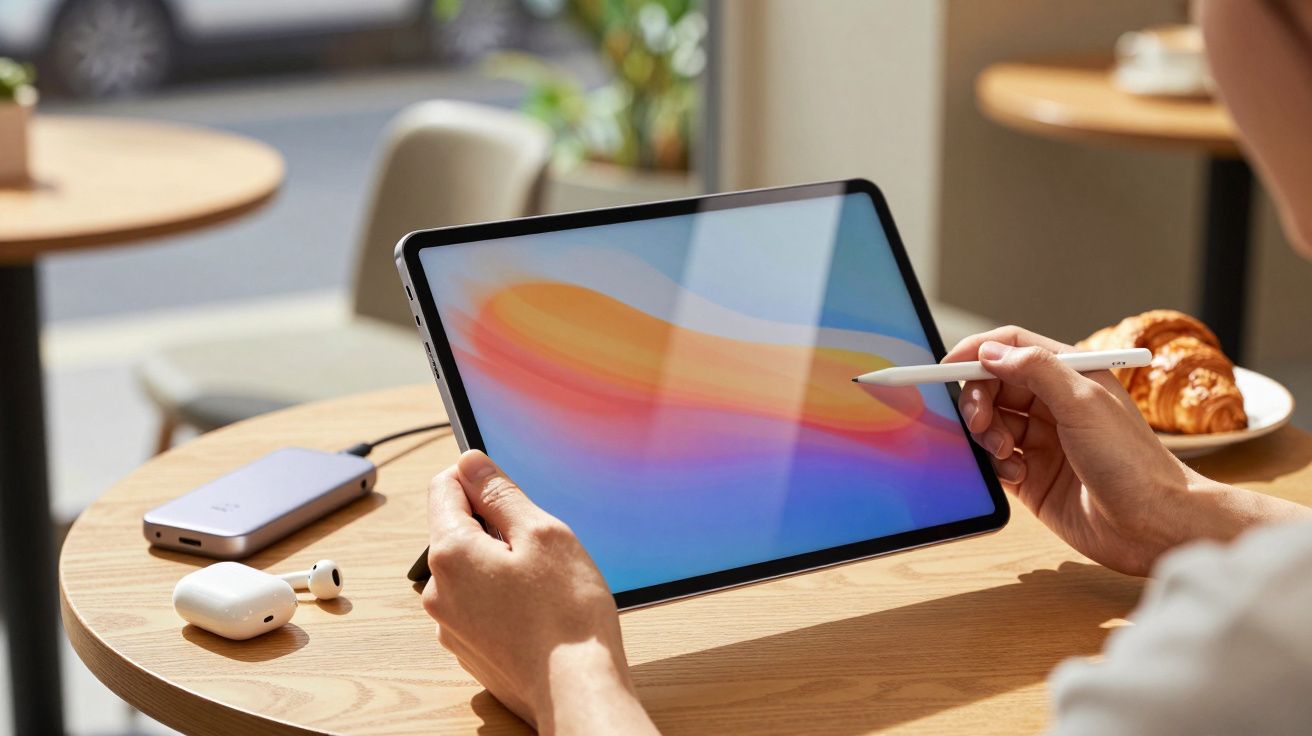
Honor has used Mobile World Congress 2026 to stake its claim to the “world’s thinnest tablet” crown, launching the MagicPad 4 with a body just 4.8 mm thick and a weight of 450 g. The new Android slate pairs that ultra-slim design with a 12.3-inch OLED display and Qualcomm’s Snapdragon 8 Gen 5, aiming to prove it is more than a styling exercise.
The question, as ever with devices this thin, is what has been sacrificed to get there. In day-to-day use, the MagicPad 4 impresses with its screen, performance and sound, but its reflective display coating, occasionally fiddly software and merely average battery life stop it short of perfection.
Price and release date in Europe
Honor says the MagicPad 4 goes on sale from 2 March 2026. It will be offered in white or grey.
Pricing is set at:
- €699 RRP for 12 GB RAM / 256 GB storage, with a launch price of €599
- €799 RRP for 16 GB RAM / 512 GB storage, with a launch price of €699
Design: impressively thin without feeling flimsy
The MagicPad 4’s headline numbers are hard to ignore: 4.8 mm thick, 450 g, and a 12.3-inch display. Its uniform 4 mm bezels help frame the panel neatly, creating the sensation you are holding little more than an OLED sheet.
Despite the wafer-thin chassis, the tablet feels reassuringly rigid in the hand and does not readily flex under pressure. That said, the IP40 rating offers limited reassurance against dust and no meaningful protection from liquids, making it a poor candidate for bathroom viewing or recipe duty near a sink.
For context, Huawei previously held bragging rights for a particularly light 12-inch-class tablet with its MatePad Pro 12.2; Honor’s new model now undercuts that in weight while also pushing slimness further.
Display: a major upgrade to OLED with 165 Hz refresh
Honor has clearly responded to criticism levelled at the previous generation’s weaker LCD panel. This time, the company fits a 12.3-inch OLED screen with a 3000 × 1920 resolution, working out at around 290 pixels per inch.
The panel also supports a refresh rate of up to 165 Hz, a figure more commonly associated with gaming monitors. In typical sofa-and-bed use, the result is a crisp, smooth display that looks every bit like a flagship tablet screen should.
Performance: Snapdragon 8 Gen 5 and modern connectivity
Under the hood, Honor moves from the Snapdragon 8 Gen 3 to Qualcomm’s Snapdragon 8 Gen 5, skipping the in-between “Elite” generation that sat in the line-up. Buyers can choose between 12 GB or 16 GB of RAM, and 256 GB or 512 GB of storage.
In practical terms, there is ample power for heavyweight Android games. Titles such as Genshin Impact and Where Winds Meet run comfortably at 60 fps or more (where available) with graphics settings maxed out.
The chipset also brings up-to-date wireless support, including Wi‑Fi 7 (though without the 6 GHz band) and Bluetooth 6.0, which should help future-proof the device for the coming years.
Audio: eight speakers and a confident, balanced output
Honor has put real emphasis on sound, equipping the MagicPad 4 with eight speakers and support for DTS:X Ultra, spatial audio, and IMAX Enhanced certification.
At high volumes the tablet stays composed, avoiding harsh distortion while keeping voices, music and film effects well balanced. Bass is understandably limited given the sub‑5 mm chassis, but overall audio quality is a clear strength.
Where the MagicPad 4 could improve
A highly reflective screen coating
While the OLED panel itself is excellent, the glossy finish reflects light aggressively. Honor quotes a peak brightness of 2,400 nits, which is generally fine indoors, but reflections can make darker scenes harder to see if you are sitting with a window behind you.
It is worth bearing in mind if your summer plan involves watching something like Stranger Things outdoors.
No reliable palm rejection for the ultra-thin bezels
Those slender bezels look great, but they leave little room to rest your fingers without accidental touches. Some rivals use software-based palm rejection to distinguish intended taps from unintended contact; the MagicPad 4 does not appear to offer an equivalent solution.
In practice, this can cause frequent mis-inputs. One example: in YouTube, thumbs resting near the edges can trigger speed-up gestures, and minor shifts in grip can lead to unintended 10-second skips forwards or backwards. This feels like something Honor could address in a software update without changing the hardware.
Software that looks polished but feels inconsistent
Out of the box, the MagicPad 4 runs Android 16. Visually, the interface is sleek and fluid, with transparency effects that nod towards Apple’s design language while remaining readable. However, customisation can be more awkward than it needs to be.
There is no app drawer, meaning every app-rarely used tools and non-removable system apps included-ends up on the home screens. Honor provides a “parallel space” option to hide apps behind a password, but it is a clumsier solution than a simple app library.
Even basic actions can be unintuitive. Changing the wallpaper, for example, is not accessed via the familiar press-and-hold on an empty area; instead it requires a pinch gesture, then navigating through menus such as “Wallpaper and style”, and granting file access before your own images appear. In reality, it may be quicker to set a background via the Gallery.
Honor also includes a PC mode designed for keyboard use and floating windows. While the idea is sound, it overlaps with capabilities already present in Android, and the tablet appears to require this mode to split the screen properly-something many competitors offer more directly.
One positive: Honor promises six years of Android and security updates.
Battery life is only average for 2026
Ultra-thin hardware leaves less room for a battery, though Honor has still managed to fit a 10,000 mAh cell. Even so, endurance lands at the lower end of current expectations.
With mixed use-note-taking and streaming services such as YouTube or Twitch-expect roughly 8 to 10 hours, and you are unlikely to get through two full days without recharging.
Charging is rated at 66 W, but achieving that speed appears to depend on using Honor’s own charger, sold separately for €50. Using a 120 W USB Power Delivery charger from Anker, a full charge took around three hours.
Verdict: a standout hardware package held back by a few software frustrations
On hardware alone, the Honor MagicPad 4 is a strong result: exceptionally slim and light, fitted with a genuinely impressive OLED panel and powered by the Snapdragon 8 Gen 5, making it not only one of the thinnest tablets around but also among the fastest. Minor compromises-reflections and middling battery life-feel like the trade-offs required to reach its headline design.
The bigger opportunity lies in software. A more intuitive approach to navigation, customisation and touch rejection would go a long way, and the good news is that these issues should be fixable via updates.
Scorecard and ratings
Overall score
- 7.3/10
Category ratings
| Category | Rating |
|---|---|
| Design & ergonomics | 7.5/10 |
| Display | 8.5/10 |
| Battery life | 7.0/10 |
| Operating system | 6.5/10 |
| Value for money | 7.0/10 |
What we liked
- Excellent display, despite the reflections
- Serious performance on tap
- Strong audio quality
- Class-leading thinness and low weight
What we liked less
- Battery life is only just adequate
- Charging is not especially quick without the right charger
- Software experience can feel unintuitive




Comments
No comments yet. Be the first to comment!
Leave a Comment