
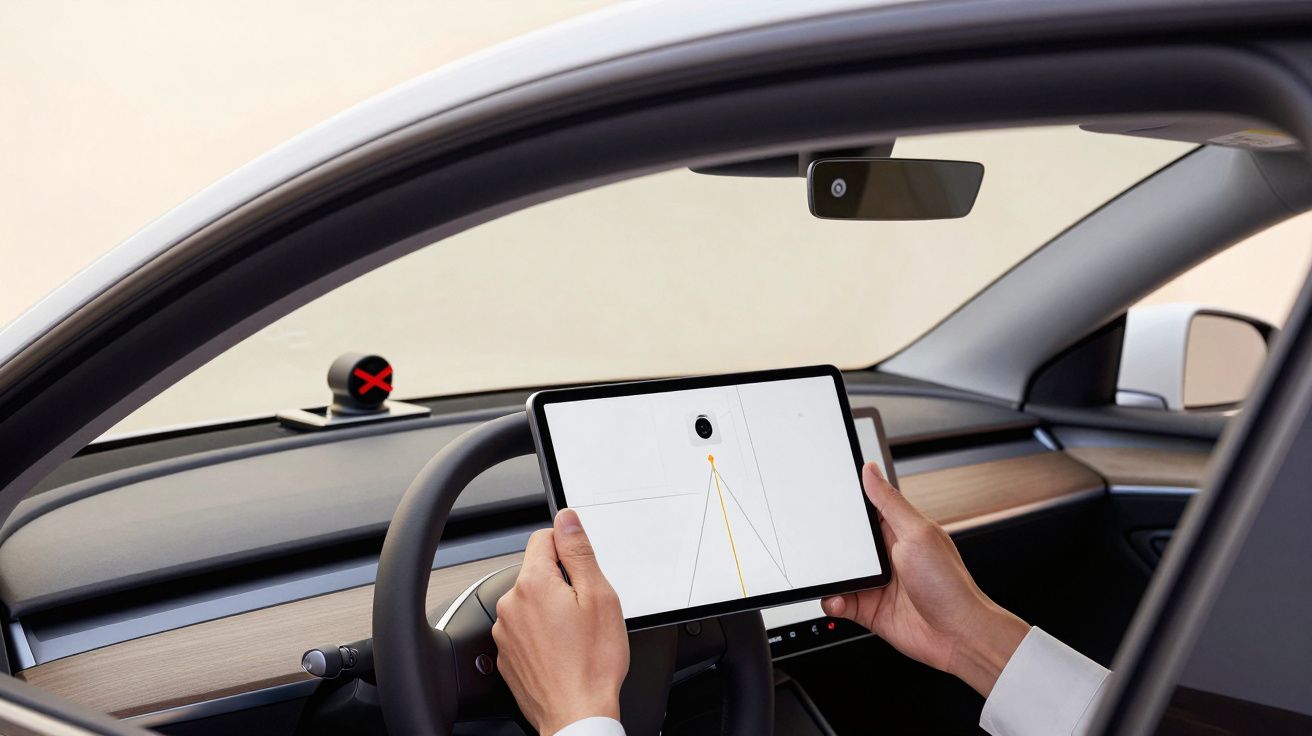
Tesla has again set out its hard-line view on the future of autonomous driving, arguing that the biggest challenge is not fitting cars with more sensors but teaching software to understand what it is seeing. In comments shared via the official TeslaAI account, Tesla’s Vice-President of Software, Ashok Elluswamy, said the core problem for Autopilot is artificial intelligence, not hardware.
“Seeing” is not enough - vehicles must interpret and predict
Elluswamy said self-driving technology is often mistakenly treated as a task that can be solved by adding ever more sensors. Tesla’s position is that what matters is not simply a car’s ability to capture images of the road environment, but its capacity to interpret that information and anticipate the behaviour of other road users.
In Tesla’s view, modern cameras already deliver sufficient visual data; the difficult part is extracting meaning from it - a job the company says falls squarely to AI.
Why early self-driving programmes piled on hardware
Elluswamy traced the sensor-heavy approach back to the early days of autonomous driving development, around 2008, when computing power and algorithms were not yet strong enough to analyse video effectively. At that stage, engineers often compensated with extra equipment such as lidar, radar and other devices because software could not reliably make sense of camera imagery alone.
Tesla says AI progress now makes simpler hardware viable
Tesla now argues that advances in artificial intelligence make that level of hardware complexity unnecessary. The company continues to develop driver-assistance systems built primarily around cameras and neural networks, emphasising scalability and training on real-world road data.
Tesla also says a camera-and-software strategy can help the system adapt more quickly for different markets, where road layouts, driving styles and rules vary.
China plans: more spending on AI and software from 2026
Tesla representatives in China have previously confirmed the company intends to substantially increase investment in AI solutions and software in 2026. To support that effort, Tesla has already established a dedicated neural-network training centre in the country, aimed at preparing models locally for Chinese traffic scenarios and infrastructure.
The wider bet: smarter software over more “kit”
Tesla’s stance underlines a broader claim: the future of intelligent driving will be decided less by the amount of hardware on a vehicle and more by the sophistication of its software reasoning. If AI can learn to interpret road situations with human-like flexibility, Tesla’s reliance on cameras could prove not only cheaper but also more suitable for mass-market cars in 2026.




Comments
No comments yet. Be the first to comment!
Leave a Comment